Worth knowing:
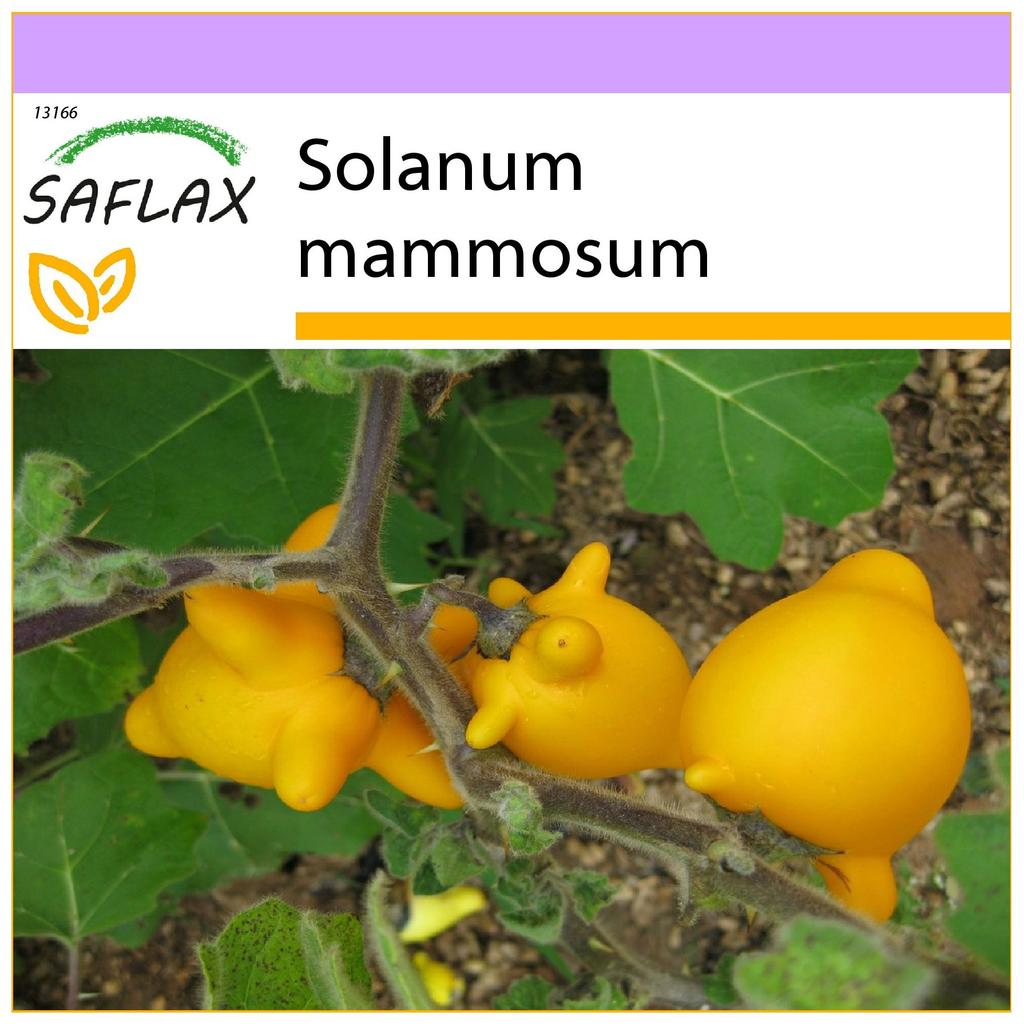
The prickled Nipplefruit is a shrub with big leaves and funny-looking, eggplant-like fruits that grows up to two meters high. It develops initially light-purple coloured buds that bring out dark-purple blossoms, and finally the bright-yellow fruits with many convexities that remind one of a cow’s udder. The rather comical plant can easily be cultivated indoors - and since the fruits stay for quite a while at the stalks, they are suitable as decoration in a vase.
Natural Location:
The Love Apple originally comes from northern South America, where it grows exclusively in tropical regions.
Cultivation:
Seed propagation indoors is possible throughout the year. To increase the germinability, you should place the seeds initially for about 12 hours in a bowl with lukewarm water for priming. After that, spread the seeds onto moist potting compost, put just a little compost earth on top and cover the seed container with clear film to prevent the earth from drying out. Don’t forget to make some holes in the clear film and take it every second or third day completely off for about 2 hours. That way you avoid mold formation on your potting compost. Place the seed container somewhere bright and warm with a temperature around 25° Celsius and keep the earth moist, but not wet. Usually it takes two to three weeks until germination - in some cases it may even take up to eight weeks.
Place:
As a tropical plant, the Love Apple prefers sunny places. During summer it can easily be kept in a wind-protected and sunny spot outdoors.
Care:
Water the plant plentiful as soon as the upper layer of the earth has dried out, but see that you avoid waterlogging, for instance in the saucer. During growth, your Nipplefruit needs fluid fertilizer for tub plants every three weeks.
During the winter:
Ideally, the Love Apple hibernates in a bright and frost-free place with a temperature around 8° to 12° Celsius. Water the plant modestly, just so the roots don’t dry out.
Picture credits:
- © © Raffi Kojian - CC-BY-SA-3.0 - http://creativecommons.org/licenses/by-sa/3.0
- © Frank Laue - © Saflax - http://www.saflax.de/copyright
- © Frank Laue - © Saflax - http://www.saflax.de/copyright
- © Raffi Kojian - CC-BY-SA-3.0 - http://creativecommons.org/licenses/by-sa/3.0
- © - -
- © - -
- © - -
- © - -
- © - -





 No-delivery refund